Hi
Hope you had wonderful weekends wherever you may be. I’m fresh back from a week’s leave in Laos chasing elephants and having a wonderful time with family – recommend 🇱🇦🤩😍
Anyway, enough travel talk – a few notes from the world of AI to kick off your Mondays:
Microsoft Copilot: The AI Companion That Speaks Your Language
Microsoft has just announced significant updates to its Copilot AI platform, introducing features such as Copilot Voice for natural conversations, Copilot Vision for real-time visual understanding, and Think Deeper for complex problem-solving. The controversial Recall feature (released and then rapidly recalled in June) also makes a return as an opt-in feature. It seems that the aim is to make AI interactions more intuitive – reducing the friction for users bringing AI into their workflows.
Will be interesting to see how these improvements, most especially Voice Mode, play with late adopters. Talking to an AI and having it respond in real time is a gamechanger and I can see this potentially being a tipping point for those who’ve been sitting on the fence – after all, something you talk to is more companion than software – potentially reducing that friction for some. On that, I’ve spent the last week or so playing with Advanced Voice Mode – both as a real-time interpreter (super good) as well as having some pretty out-there discussions with it. Conversation is so seamless you can forget you’re talking to a machine. Sounds weird but definitely recommend giving it a shot #shadesofHer
ChatGPT Canvas: OpenAI’s New Playground for Seamless Human-AI Collaboration
OpenAI are also reimagining how we work with AI with the release of Canvas for ChatGPT, designed to enhance human x AI collaboration. Unlike the traditional chat interface (and somewhat similar to Claude Artifacts), Canvas opens in a separate window, allowing users to work alongside ChatGPT on more complex tasks. How can you use that in practice? Think smart feedback systems (highlight specific text to receive targeted insights and instant AI-powered editorial suggestions), flexible editing capabilities (now you can fine-tune outputs without overhauling the whole document #loveClaudebut…), integrated research functions, and more.
There is an argument to be made that the whole AI revolution we are going through now is as much a User Interface (UI) revolution as a technological one – putting these incredibly powerful, technical tools in the hands of less or even non-technical people. The changes that Microsoft and OpenAI suggest they recognise this and are proactively removing barriers to engagement. Incredible stuff 🤩
Rethinking Bloom’s: A Learning Taxonomy for the AI Era (Hardman)
Are traditional taxonomies of learning like Bloom’s still relevant for how we design and assess learning in a post-AI world? An important question from the excellent Dr Philippa Hardman , who offers an interesting alternative to the classic Blooms with a potential Post-AI Learning Taxonomy.
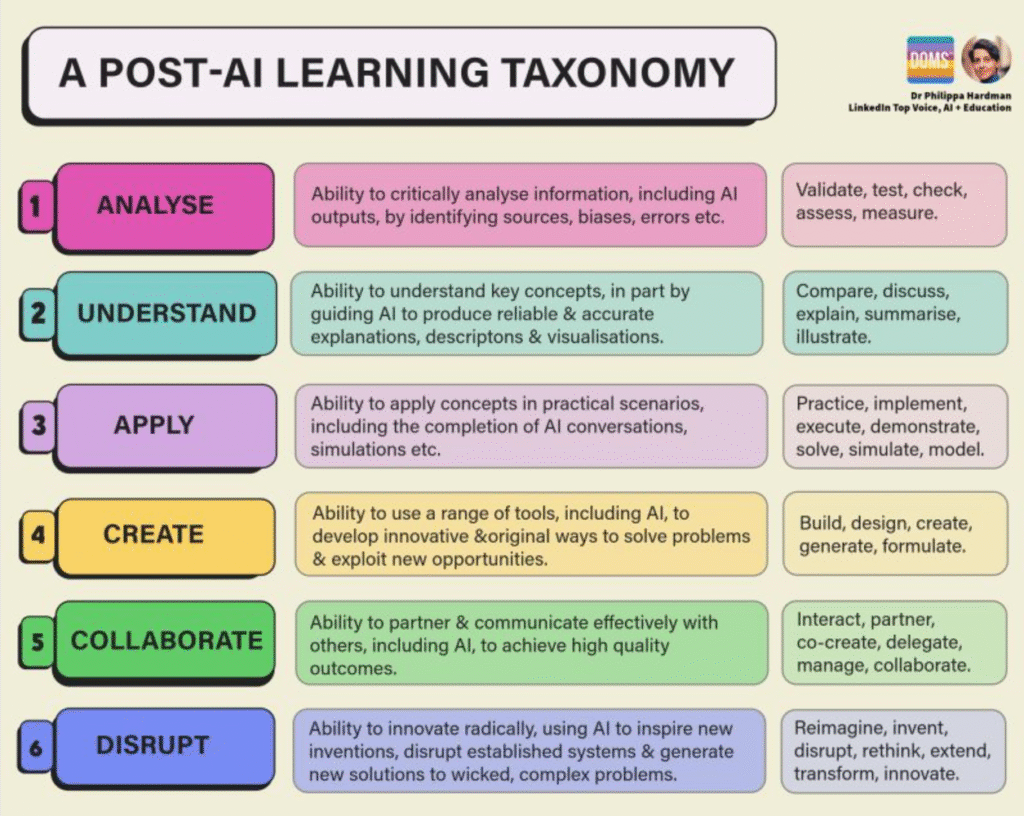
A new model of learning for the Age of AI?
One thing you might notice straight away is the absence of a “Remember” level – Hardman suggests that perhaps value has shifted from mere memorisation of vast amounts of information to something deeper – embedding it within a more comprehensive learning process. By requiring learners to actively research, validate, and apply information, this updated taxonomy aims to foster deeper understanding and more effective long-term retention than traditional rote memorisation.
Assessment, particularly around academic integrity, has dominated a lot of the conversation to date but there is clearly room for discussion on other aspects of current education models. What do others think?
Digital Shadows: The Hidden Curriculum AI is Writing in Our Schools (Mishra)
“We’re not just dealing with a new form of bullying or harassment; we’re confronting a technology that can weaponise identity itself”.
In a sobering but extremely timely read,Punya Mishra argues that the most significant impacts of generative AI on education may occur outside the classroom, fundamentally altering the educational landscape. He highlights the concerning trend of AI-generated “deepfakes” being used to create nonconsensual, sexually explicit images of students, with 15% of high schoolers reporting awareness of such incidents. This underscores the need for educators to look beyond AI’s immediate classroom applications and consider its broader societal implications.
Mishra emphasises that focusing solely on integrating AI into curricula or enhancing learning outcomes is insufficient; instead, educators must address the wider ecosystem shaped by AI’s capabilities and risks. He advocates for a more comprehensive approach to designing education that encompasses systems and culture, rather than just artefacts and processes. A conversation perhaps long overdue.
Pika 1.5: Pushing the Boundaries of AI-Generated Video
Pika Labs have been quiet for a while (looking at you too Sora) – leaving Runway and Kling to dominate the AI video conversation. That said, they have been putting in work and have just released Pika 1.5.
Pika clearly have a niche in mind – they’re leaning into big screen shots (think Matrix-style bullet time) and mind-bending Pikaffects that defy the laws of physics. Lots of fun – try it for yourself here. 🎬
The rapid evolution of AI technology is fundamentally transforming HE, offering unprecedented opportunities for enhanced learning experiences and collaboration. From more intuitive AI assistants to reimagined interfaces and AI-generated content, we’re witnessing a revolution that’s not just technological but also represents a significant shift in how we interact with these powerful tools. These advancements are making AI capabilities more accessible, potentially democratising complex technologies for educators and students alike.
However, this AI revolution also brings substantial challenges that demand our attention. The rise of AI-generated deepfakes in educational settings and the need to rethink traditional learning models underscore the broader implications of these technologies. As we move forward, it’s crucial for HE institutions to adopt a holistic approach that considers not only the integration of AI into curricula but also its impact on systems, culture, and student wellbeing. By doing so, we can harness the immense potential of AI while mitigating its risks, ensuring that it serves the best interests of learners and society at large.
Anyway, still hosting so will leave you with this image of an elephant peeking out from behind a tree. Until next time! 🤩🐘🤖

In all serious, the Elephant Conservation Centre outside of Luang Prabang does wonderful stuff – definitely worth a look!