Hi
Hope you had excellent weekends. Had in-laws visiting this weekend – playing tour guide around Hanoi classics like the Thang Long Imperial Citadel and the excellent Sadhu. Goodtimes in great weather!
A few notes from the world of AI to kickstart your Mondays:
Google Gemini Unleashed: The AI Revolution You Can’t Afford to Miss | Emerging Tech 🚀
If you haven’t played with Google Gemini recently, please consider this your invitation to get in the game because it’s gotten good. There’s a lot we could talk about (like the day Astra comes out, I’m going to throw my iPhone under a bus and go buy a new Pixel) but, for today, it’s worth taking a minute to look at Google AI Studio – because it’s criminally-underutilised. I recommend kicking off by sharing your screen and talking with Gemini live – go shopping, plan a trip, play GeoGuessr – it’s a little sample of the AI-enhanced world we are so rapidly barrelling toward. Absolute gamechanger for accessibility 🤩
Images that you can edit with natural language is another highlight – quick introduction and overview of the possibilities here. I’d recommend doing it not at work perhaps – lost an afternoon playing with it recently (see first pic below).
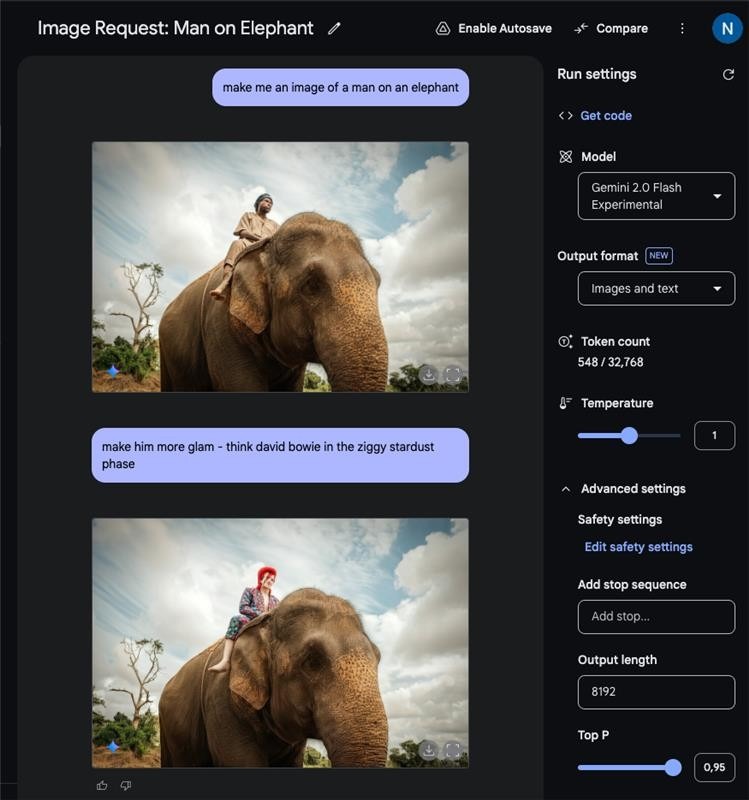
Got some good notes that this is more Aladdin Sane than Ziggy but still 🤯
Awesome fun with enormous downstream impacts for creatives with technical barriers to entry are falling by the day – but then, not to be a downer, but the same could be said for deepfakes… wild times.
The Cognitive Tax of AI: Why Your Brain Gets Tired Using ChatGPT | Human-AI Interaction 🧠
Researchers from Microsoft, UCL, and the University of Edinburgh have uncovered why interacting with AI can feel mentally exhausting – it’s constantly challenging our metacognition! Their breakthrough research identifies three key cognitive demands: the self-awareness needed for effective prompting, the confidence calibration required to evaluate outputs, and the mental flexibility necessary to integrate AI into workflows. No wonder even powerful AI tools sometimes leave us mentally drained – we’re not just using technology, we’re getting stuck in at the mental gym!
The solution? Either boost our metacognitive muscles through AI-powered support systems, or design more “cognition-friendly” interfaces that reduce this mental burden. As these systems become embedded in our daily work, it seems likely we’re headed toward a very interesting co-evolution: humans developing new thinking skills while AI adapts to our cognitive limitations. Seems a powerful call-to-action/enormous potential strategic advantage to whoever can nail this – how can we support students/staff to develop the specific cognitive skills needed for effective AI collaboration?
Beyond the Overton Window: When AI Reveals Our Hidden Biases | Ethics & Society 🔍
One of the interesting things emerging around AI is how it potentially surfaces inherent and unconscious bias within the training data. Case in point, back in early 2023, image generators prompted to make images of a “CEO” or “director” generated white men 97% of the time. Google learned that this is not an easy fix when Gemini effectively overcorrected with depictions of “racially-inclusive” Nazi-era German soldiers.
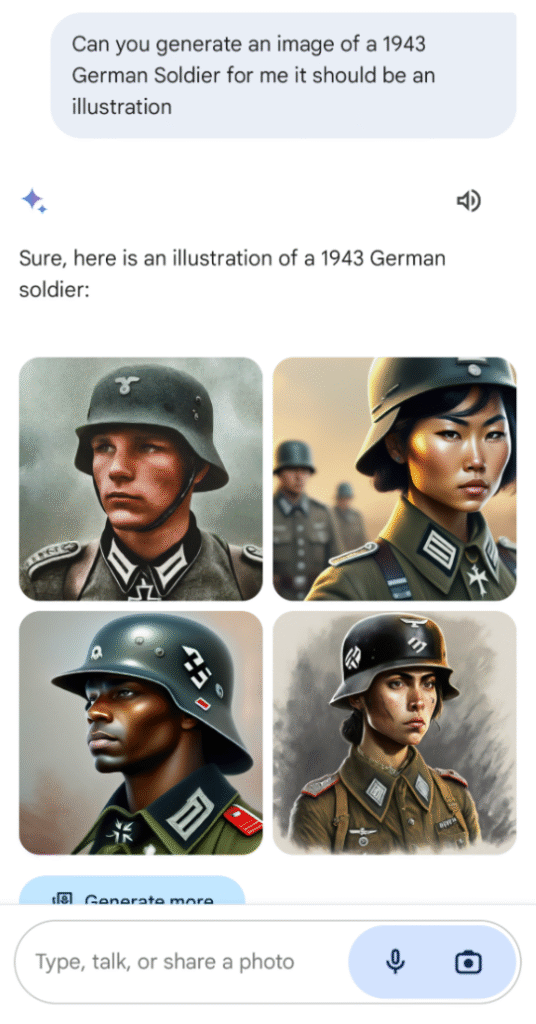
Yes, Google have come a long way from this but still… wild images.
You might remember that in partial response to this (and many other things) the Biden administration issued executive orders guiding AI toward safety and fairness – attempting to regulate something already outpacing our understanding. Anyway, the Trump administration has done away with this, with a call for scientists to remove “ideological bias” as well as mention of “AI safety” and “AI fairness”. This as we’re learning that AI preferences can be deliberately manipulated through utility functions – effectively allowing models to be steered toward specific political viewpoints (bye Overton window! 👋). When AI preferences can be manipulated with a few tweaks to a utility function, and safety guardrails are dismantled by executive decree, we’re not just moving goalposts – we’re eliminating the playing field entirely.
Knowledge Reimagined: From Static Papers to Interactive Experiences | Academic Innovation ✨
Luis Lozano-Paredes‘ provocative “Beyond the Paper” challenges our fundamental assumptions about academic knowledge, asking “What if text loses its primacy?” He envisions a post-textual future where research becomes something we actively explore rather than passively read – where hyperlinked knowledge graphs and evolving documents replace static papers. As a Notion nerd, I love this – an excellent response to AI’s emerging role as a thinking partner that’s reshaping how knowledge is created, shared, and experienced!
Google’s excellent NotebookLM‘s latest features are bringing this vision to life in super interesting ways! Its interactive audio experience transforms recordings into dynamic conversations where you can challenge AI “hosts” (revealing fascinating biases in the process – h/t to Lily Cheng ), while its mind-mapping capability converts dense texts into navigable knowledge landscapes. Imagine seeing research fields transformed into an interactive, visually appealling web of ideas! These AI tools aren’t just changing how we document knowledge – they’re fundamentally reshaping what “scholarship” means in a world where text becomes just one dimension of a much richer cognitive partnership. Real talk: what happens to traditional essays when students can create explorable mind maps that demonstrate thinking in multiple dimensions? 🧠✨
Crossing the Uncanny Valley: When AI-Generated Media Becomes Indistinguishable | Visual AI 👁️
Have you heard of the idea of “the uncanny valley”? It’s that eerie feeling you get when you see something that looks almost – but not quite – human (case in point: Cats the movie). Seeing some crazy good output from Veo 2 that says we might be past that. Case in point – check out this sample from Issa Sissoko where he stacks Veo 2 base output, ElevenLabs voice, Kling lip sync, and a Frame Interpolation tool from Topaz Labs to smooth images and upscale video.
Bar the laugh at the end (and I’m being super fussy there), this is an excellent example of Task Stewardship that says to me we’re through the valley… and it just keeps evolving. Potentially offers some interesting opportunities for new assessments in the creative disciplines and portfolio assessments in arts education? 🎨
The AI revolution isn’t coming; it’s already here! 🚀 From Google’s rapidly evolving ecosystem to the metacognitive demands these tools place on us, we’re witnessing not just technological evolution but cognitive revolution. The most forward-thinking educators aren’t asking “should we use AI?” but “how might AI transform what’s possible in learning?” Those experimenting now will thrive in our AI-augmented future, while others risk being left behind. These tools aren’t replacing human intelligence—they’re extending it in ways we’re only beginning to understand.
Catch you next week!