Hi
Happy new year! Hope that your Tet/Lunar New Year breaks (if you had one) were fantastic. Me, I’m not long back from Kerala – an amazing, warm change from Hanoi’s clammy, humid cold. On that, a few notes from the world of AI to heat up your Mondays:
Google releases, and upgrades, Gemini. But OpenAI is jealous of its position as 👑
It seems like Google is making up for lost time. A week or two back, Google Bard was rebranded and formally launched as Google Gemini. Gemini features 3 models with the largest (Ultra – available via paid subscription in both 🇻🇳 and 🇦🇺) looking pretty interesting indeed. Initial reports suggested Ultra might be better than GPT4 which was wild but, not content to rest on their laurels, Google have already released a blazingly fast update – Gemini Pro 1.5. Reportedly the new Pro (read: free) model is as good as the “old” (i.e., paid) Ultra. Oh – and it has an almost comically oversized context window: 1 million tokens – roughly equivalent to the entire Lord of the Rings trilogy.
Integrations with other Google apps like GSuite, Maps, and YouTube are already rolling out – early days but the potential for an intelligent, responsive, agentic Siri/Google Assistant is there. Super interesting and for maybe 5 minutes there I thought Google was clawing back into the AI race. But then OpenAI went and set my expectations of what’s possible with AI on fire with Sora.
Sora: mind-blowing text-to-video/world builder from OpenAI – and a significant step on the road to AGI…
So the fact that ChatGPT now has a memory of what you discuss with it and can learn should be a big deal – and it is – but it’s nothing compared to this other news.
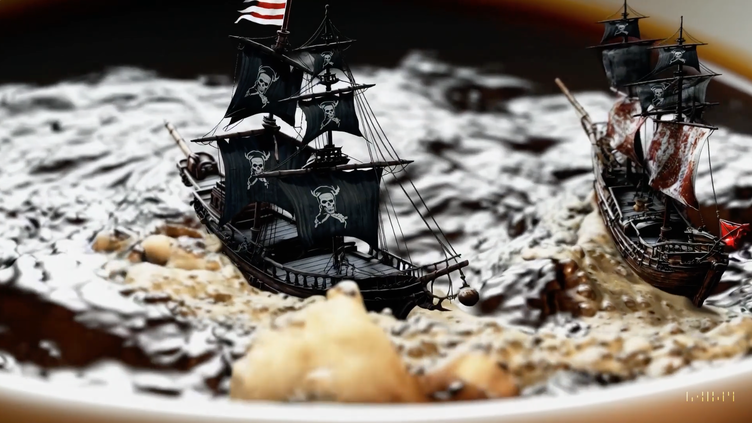
Sora is a text-to-video generator from OpenAI – and it is ridiculously good. As in, just absurdly, world-alteringly incredible. Look at the videos below – they were all made with AI. Every. Single. One. 🤯
You might think we’ve seen this before but, experts like NVIDIA’s Jim Fan are hailing it as a literal world builder “if you think OpenAI Sora is a creative toy like DALLE, … think again. Sora is a data-driven physics engine. It is a simulation of many worlds, real or fantastical”. Seriously, take a look at those pirate ships fighting in a cup of coffee – the detail consistency of the images, the movement of the water – all from a single text prompt… absolutely amazing. The prompt? Photorealistic closeup video of two pirate ships battling each other as they sail inside a cup of coffee.
And, remember – as incredible as these videos already are, the rate of progress says that sometime in the not-too-distant future, they won’t be distinguishable from real life. I’m excited, but I genuinely don’t think we’re ready for this.
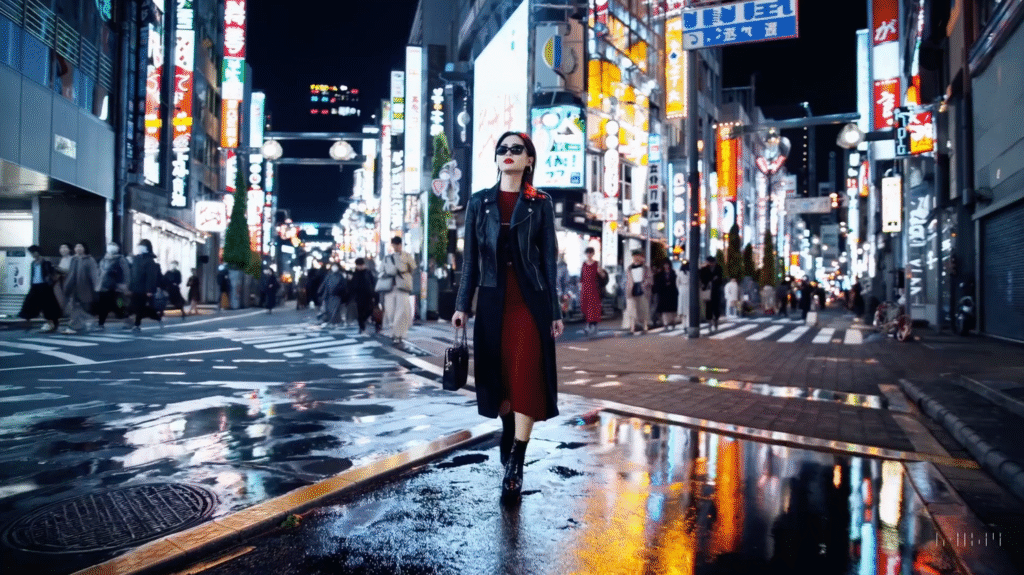
Tokyo Walk (Sora, OpenAI)
Prompt: A stylish woman walks down a Tokyo street filled with warm glowing neon and animated city signage. She wears a black leather jacket, a long red dress, and black boots, and carries a black purse. She wears sunglasses and red lipstick. She walks confidently and casually. The street is damp and reflective, creating a mirror effect of the colorful lights. Many pedestrians walk about.
Though it could go further still – the press note states that Sora serves as a foundation for models that can understand and simulate the real world, a capability we believe will be an important milestone for achieving AGI. 😮
After Deepfakes Uproar, Concrete Steps to Control AI Risks
Deepfakes have come up a few times in these updates and for good reason. It seems like concrete steps are being taken to try and bring these under control: both Google and Microsoft have integrated watermarks into their AI-generated images; Midjourney is considering banning the generation of images of politicians for the 2024 election season; and the FCC has banned robocalls. More broadly, the US Government has announced the creation of the US AI Safety Institute Consortium, uniting “AI creators and users, academics, government and industry researchers, and civil society organisations in support of the development and deployment of safe and trustworthy artificial intelligence”. Given the rapid rate of progress and development, these are important, hopeful steps.
Recordings from the ANZ AI Symposium! 👀🍿
Couldn’t make it to last month’s ANZ AI Symposium? No problem – the organisers have generously made the videos available here. With themes ranging from assessing learning in an AI age to teaching complex skills with AI, from co-creativity and inclusion to bridging theory to practice, there’s something for everyone here. Very much worth a look.
Who said AI killed creativity?
I ❤️ things like this. Filmmaker David Hayes undertook a moving AI-powered passion project exploring his great, great, great, great grandfather Rufus Archer’s world as a 19th century cooper. Combining genealogical archives with leading-edge generative video and speech synthesis, David fostered connection across generations by resurrecting Rufus’s long lost words and visual surroundings. The experimental tribute pieced together a portal to an otherwise inaccessible past, unlocking creative possibilities while revitalising family history. This is a wonderful, innovative approach – merging legacy preservation with emerging tech.
We hope this edition of the newsletter has been of interest to you. If you’re new here and it’s been useful, please do click subscribe and you can expect a weekly update every Monday from now on. If you’re already a subscriber – thanks for your ongoing interest and support! Either way, if you know others who might benefit from reading this weekly, please forward it on to them too.
Have an excellent week ahead and catch you next time!
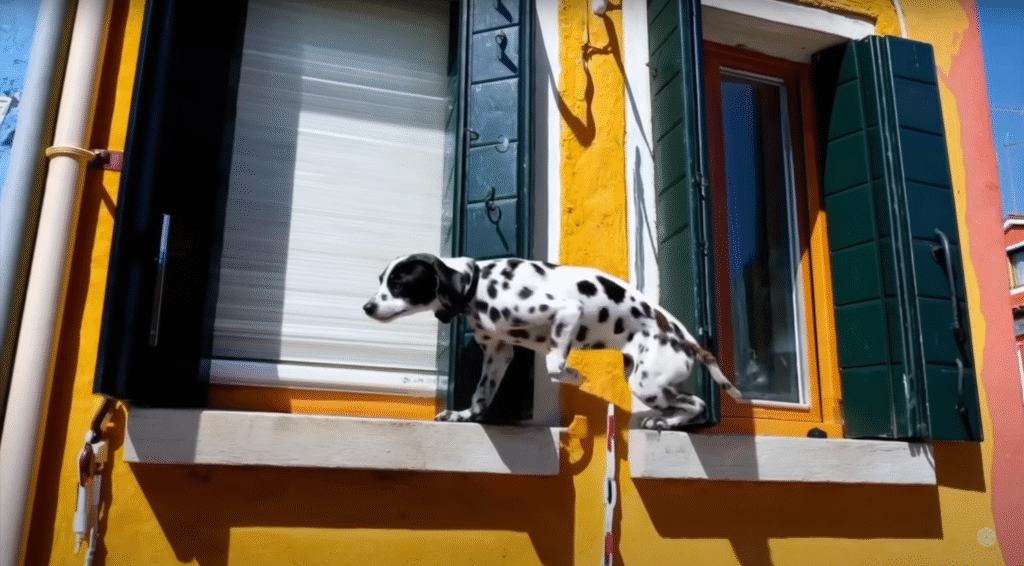
Dalmatian cuteness in Burano (Sora, OpenAI)
Prompt: The camera directly faces colorful buildings in burano italy. An adorable dalmation looks through a window on a building on the ground floor. Many people are walking and cycling along the canal streets in front of the buildings.