Hi
Hope you’re all well. To those of you in 🇻🇳, hope you had an excellent Reunification Day holiday – to those elsewhere, sorry for the radio silence – we’ve been on holiday here most of the last week #lovingit. Better late than never though, a few notes from the World of AI to wind you into your weekend:
ChatGPT’s Memory Feature: Your AI companion just levelled up
OpenAI’s ChatGPT is taking a giant leap forward with its new Memory feature, now available to ChatGPT Plus subscribers outside Europe (GDPR I guess?) and Korea (not sure about this – interesting exception). This groundbreaking advancement allows the AI to store and recall details from previous conversations, making interactions more personalised and efficient than ever before. With Memory, ChatGPT can remember your preferences, personal information, and even the context of past discussions, eliminating the need for repetition and enabling the AI to provide more relevant and insightful responses.
The implications of this development are vast, as ChatGPT transforms from a mere conversational tool into a truly intelligent virtual assistant. Imagine a world where your AI companion remembers your favourite coffee order, the name of your pet, or even your preferred writing style – all without you having to remind it constantly. See it in action below – that and a new image editing feature they’ve certainly snuck under the radar…
Digital Twins, Bots, and AI Doubles – All the way from useful to the edge of the Uncanny Valley…
This has been coming up a lot recently – interactive knowledge base GPTs, a Finance bot, a Workday AI – all good ideas there’s a real limitation in the broader awareness around this. The University of Sydney are doing some awesome things with their Cogniti AI platform including a wide range of different tutors and helpers providing personalised support and feedback, asking probing questions and, in some cases, linking this back to tutors to help identify where students struggle and need additional support. Then there are GPTs from organisations like Moderna (who’ve apparently made 700+ GPTs across the company within 2 months) including a Dose ID GPT (analysing clinical data to optimise vaccine dose selection), a Policy Bot (providing instant answers on company policies), and a Brand Storyteller (tweaking Moderna messaging for different audiences) – check out the case study here.
As cool as things like these are (and they’re awesome – seriously, we’re working on a few things like this already but if people want to explore more ideas like this, hit me up), there are platforms you can generate an AI version of yourself at scale like Delphi AI. Or, getting even further out there into the Black Mirror territory are things like this with Reid Hoffman (LinkedIn Founder) interviewing and being interviewed by his AI self.
Hoffman: Why did I deepfake myself? To see if conversing with an AI-generated version of myself can lead to self-reflection, new insights into my thought patterns, and deep truths.
Interesting? ✅ Creepy? ✅ Something we’re going to see a lot more of? ✅
“A Busy Person’s Intro to LLMs” by Andrej Karpathy
Ex-head of AI at Tesla and one of the original founders of OpenAI, Andrej Karpathy is widely regarded as one of the best AI/ML educators out there. He describes this 1-hour talk as a general-audience introduction to Large Language Models: “the core technical component behind systems like ChatGPT, Claude, and Bard” (that last reference shows it is a bit dated perhaps but still definitely worth a look). Karpe=athy covers what LLMs are, where they are headed, comparisons and analogies to present-day operating systems, and some of the security-related challenges of this new computing paradigm. Enjoy!
AI in the wild – how students are using generative AI in their learning
One thing that’s been sticking out to me over the last wee while has been the relatively limited discussion of things relating to the perspective of students in this whole piece (or at least in this newsletter). While we’ve covered things like the great work done by the University of Sydney (e.g., above) and Monash University (e.g., the wonderful 10 minute chats on Generative AI series) it seems overdue we take a moment to examine student usage. Cue Jason M. Lodge (University of Queensland):
A leading voice in the Australasian AI in HE field, Jason recently gave an excellent talk for SoTEL titled AI in the wild: How students are using AI in their learning and drawing from a significant data set (60k students from across 4 institutions), he unpacks how students are using AI to help address their learning needs – with a clear division between those using AI at a more “basic” level (i.e., as a souped-up search tool) to those more “advanced” users using it for cognitive heavy lifting before checking in with their peers on the more human, emotional sense-checking elements. Reckon there might be a few people out there who see parallels with their own use-cases… 😉
Beyond the Hype – the reality of OpenAI’s Sora x Air head 🎈
Remember that ‘air head’ video the shy kids team made with OpenAI’s Sora? Turns out it used a ton of rotoscoping and manual VFX. “While all the imagery was generated in SORA, the balloon still required a lot of post-work. In addition to isolating the balloon so it could be re-coloured, it would sometimes have a face on Sonny, as if his face was drawn on with a marker, and this would be removed in After Effects. Similar other artefacts were often removed” (see pic).
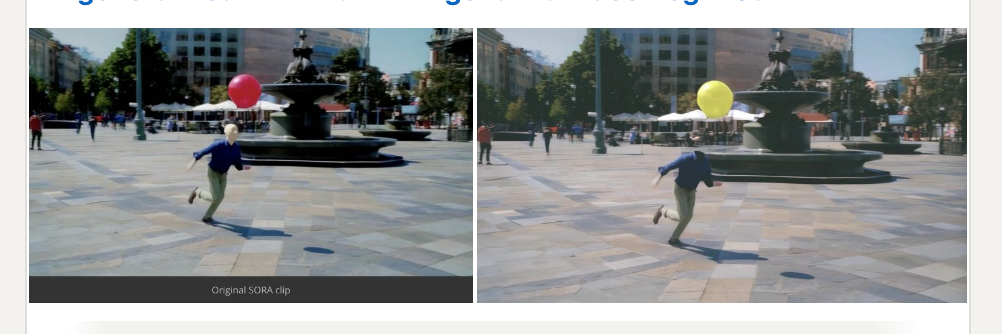
Still awesome – just not as earth-shaking as we’d thought…
Bit of a drag (or a relief? Both are probably true) – that said, it’s important to remember that text-to-video has moved a looong way this last year: after all, from the Genesis trailer (below) which came out about 9 months ago now to Sora and, in the last week or so, China’s new Sora rival, Vidu. #interestingtimes
We hope this edition of the newsletter has been of interest to you. If you’re new here and it’s been useful, please do click subscribe and you can expect a weekly update every Monday (bar holidays…) from now on. If you’re already a subscriber – thanks for your ongoing interest and support! Either way, if you know others who might benefit from reading this weekly, please forward it on to them too.
Have a great weekend ahead and let us know if there’s anything we’re missing that we should add to make this newsletter more useful for i) yourself and/or ii) others. This is a fast-moving, ever-evolving space and we greatly value any and all feedback. 🙏