
Hi
Hope you had a great weekend wherever you may be. Mine was spent coming down from a high off the back of a very successful inaugural Higher Education Horizons 2024 event at RMIT Vietnam. Great keynotes and panel speakers, amazing showcase, and well-attended afternoon workshops all the way through! Already got people asking what’s planned for next year #watchthisspace
Anyway, a few headlines from the world of AI to kickstart your Mondays:
AI Safety and Privacy: From Responsible Scaling to On-Device Solution
Sam Altman (OpenAI) and Dario Amodei (Anthropic)’s recent l̶o̶v̶e̶ ̶l̶e̶t̶t̶e̶r̶s̶ essays on the potential of AI in the not too distant future has me thinking a lot about AI safety*. Two interesting things from the last week or so for people who share these concerns:
The team behind Claude is taking steps to better manage risks from advanced AI systems with their updated Responsible Scaling Policy. The new framework introduces capability thresholds that trigger stronger safeguards as AI capabilities grow, with specific focus on autonomous AI research and assistance in creating harmful technologies like CBRN weapons – extra points for adding scrutiny from external experts.
I’ve been tinkering with on-device AI for a while now. While the models available there are not as good as Claude 3.5 or ChatGPT o1 (yet), they’re getting better by the day and there’s a lot to be said for it as an approach.
- Increased security and privacy? ✅ These AI run on your laptop, tablet, or phone so there’s no data pass to data-hungry companies like OpenAI. Potentially a great way to leverage AI while respecting privacy and security concerns like student PII
- Sustainable? ✅ Big one for people using ChatGPT/AI as a replacement for Google – did you know you can use as much as 500ml of water in a relatively short conversation with ChatGPT? The massive data centres behind these platforms use a lot of water – roughly equivalent to what the energy-guzzling crypto industry requires.
Anyway – want to try it out for yourself? Leon Furze has an excellent primer to help you get started with running local AI today. This is a fantastic way to get hands-on today 10mins or less – recommend!
Or maybe you’re past that beginner stage? Then definitely check out Mitko Vasilev who does some truly spectacular stuff (e.g., a local Notebook LM-style Audio overview podcast?). Again, not for beginners but Vasilev is on point when he says: “make sure you own your AI. AI in the cloud is not aligned with you; it’s aligned with the company that owns it.”
*See Altman’s The Intelligence Age here and Amodei’s Machines of Loving Grace here. Interested readers might want also want to check out Mustafa Suleyman (Founder Google Deepmind, ex-CEO Inflection AI, and current CEO Microsoft AI)’s book The Coming Wave: Technology, Power, and the Twenty-first Century’s Greatest Dilemma.
Supercharge Your Strategic Planning with AI: From Boardroom to Classroom
Can you believe it’s only about nine weeks to Christmas?!? If your workplace is anything like mine, that means you’re probably working on annual reports for 2024 and looking ahead with plans for the new year. Real talk: if you’re not bringing AI into those conversations, you’re missing out. Give it your ideas and ask it what you’re missing (those “unknown unknowns” to cite Donald Rumsfeld for perhaps the first and last time in my life), or ask it to conduct gap analysis.
Allie K Miller’s excellent Maven workshop (Two Real Ways to 10x Your Team with AI) highlights this as a great trick where her team prompts an AI to identify any legal, financial, product, and user considerations they hadn’t considered. That and AI breaks – excellent idea #stealingthat. Or have it take an antagonistic position to help you refine and sharpen your position – or just about anything else. Great case study from HBR that shows how CEOs are leveraging this approach as well – worth a look and extra points if you do this using Advanced Voice Mode.
The Great AI Detection Debate: Why Your Essays Might Be Falsely Accused
HE Horizons 2024 last Friday was a blast – fantastic keynote and panel with speakers drawn from across Vietnam and the wider region. The AI in Action and Learning Design workshops in the afternoon were well-attended with excellent feedback coming through – and some surprising (or maybe not) questions about AI detectors. Worth saying again, categorically: AI-generated text cannot reliably be detected.
Great breakdown on this from Bloomberg (AI Detectors Falsely Accuse Students of Cheating – With Big Consequences) showing leading AI detectors confidently labelling essays written before the release of ChatGPT as “likely written by AI”. 1-2% error rates don’t seem like a lot but when you’re talking about hundreds, thousands of essays – that adds up quickly:
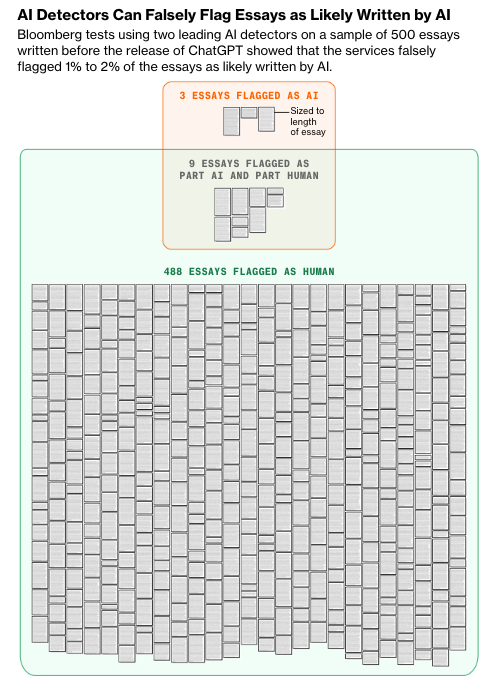
AI detectors: So advanced, they catch AI-generated essays from before AI even existed!
And given these are people on the other end of those submissions, approaching this in a punitive fashion is deeply unhelpful and even perhaps immoral when students can be accused with this and have no way to prove their innocence. And then there are things like the emerging class of AI Humanisers like Hix Bypass that can “Generate human-like, undetectable writing… Plagiarism-free guaranteed!”
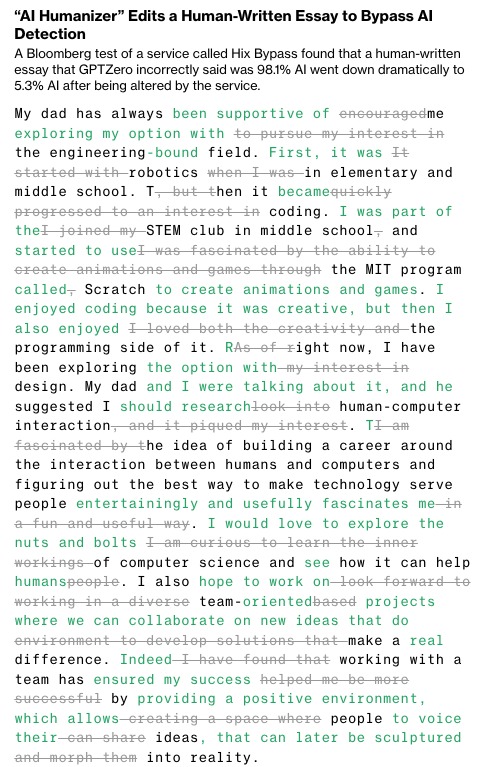
AI Humaniser: Because nothing says ‘authentic human writing’ like having a robot rewrite it for you…
Or then maybe you need an AI detector for your next Zoom call… 🤯
Digital Doppelgangers: Are AI Avatars the Future of Communication?
HeyGen have released Zoom avatars (interactive AI avatars that attend meetings for you) – wild stuff and confirmation that we live in a very weird time. Use-cases? HeyGen is pitching it for customer support, sales calls, job interviews, and therapy among other things – with education being right up there as well. It looks like they’re still pretty detectable (and annoying) for now but that will change with time and given their development map has avatars becoming more agentic – making decisions, scheduling follow-ups, and performing actions based on meetings outcomes – this might be a bit of foreshadowing of things to come with the rise of agents.
The case could be made that this is a solution in search of a problem but then, as someone who works with people across multiple time zones and has to attend some very-early or very-late meetings as a result, I can see some appeal in there with an avatar connected to an individual’s knowledge base, emails, documentation, meeting notes, etc. If nothing else, remember those TikTok’s of Kim Kardashian and Taylor Swift teaching maths a while back? Potentially an interesting extension of that… but personally, this feels like a lot from a social point of view at the moment/not sure we’re ready for this just yet…. what do others think?
Adobe Max 2024: Unleashing Your Creativity with AI-Powered Tools
Adobe Max was last week and they did not disappoint with a long list of new features and AI tools being announced. Creative Cloud users have a lot to look forward to with new features like Generative Expand and Distraction Removal coming to PS, Enhanced Image Trace to Illustrator, Generative Remove to Lightroom, Generative Extend to Premier to name but a few on the way. Interesting to see Adobe moving into Gaussians and there are already some cool exemplars of workflows integrating Hailuo, Luma, and Runway for some pretty exciting results 🤩
Adobe is already teasing new things though with a new Firefly Video model coming soon (join the waitlist here) and a series of what they’re calling Adobe “Sneaks”. Essentially Sneaks are internal projects that aren’t yet available as products yet – we’re talking Turntable (rotate your 2D vectors), PerfectBlend (seamlessly editing photos by adding people or objects), RemixALot (turn sketches into fully-rendered images – while also being an awesome Golden Age hiphop reference) and a whole lot more. Well worth a look!
As we navigate this rapidly evolving AI landscape, from safety protocols to creative tools, it’s clear that AI is reshaping how we work, create, and communicate. Whether you’re excited about on-device AI, curious about AI avatars, or looking to leverage AI in your strategic planning, there’s no shortage of opportunities to explore.
Remember, this whole space thrives on shared insights and experiences. Have you tried any of these new AI tools? What are your thoughts on AI detection in academia? Share your experiences or questions in the comments below.
Stay curious, keep experimenting, and let’s continue to learn and grow together in this AI-powered world. Until our next update, keep pushing the boundaries of what’s possible with AI! 🤩