
Hi
Hope you had wonderful weekends – esp. those of us in 🇻🇳 who were lucky enough to enjoy a day off Thursday for the Hung Kings Festival. ❤️ me a mid-week weekend! A few quick notes from the world of AI to kick off your Monday:
Llama 3: Meta’s Open-Source Powerhouse Challenges AI Frontrunners #andthentherewere4
Meta’s Llama 3 is here (well, not outside of the US as yet but if someone wants to bookmark this page and let me know when it’s available, I’d be grateful 🙏). Meta is making some big claims on just how good it is, calling it the most capable openly available LLM to date and claiming that it outperforms Claude 3 and Google Gemini – see it in action below.
Big calls for sure but the interesting thing is that this model is much smaller than those it’s being compared to (8bn and 70bn paramaters) – and the big version (400bn parameters) is still being trained. This begs the question – just how good will that one be? That and the fact that Llama 3 is open source has a wide range of stunning implications in how it can be used – e.g., a strong home AI that can run your systems/business/home.
Ultimately this isn’t a surprising announcement as such as we’ve been expecting Llama 3 to come in 2024 and we’ve covered some of the enormous investments that Meta is making in this space (e.g., here). It’s worth noting though that earlier this year Meta boss Mark Zuckerberg made no bones in stating his/Meta’s ultimate goal is to achieve AGI and that unshaking commitment doesn’t appear to have changed with statements like this coming just this last week: “That’s not even a question for me – whether we’re going to go take a swing at building the next thing. I’m just incapable of not doing that”.
Otherwise, keep an eye out OpenAI’s reply drop/announcement any day now – Sam Altman is never one to let other companies hog the limelight for long.
🚀 AI’s Rapid Rise: U.S. Tech Giants Dominate, Sparking Excitement and Apprehension
The 2024 AI Index Report by the Stanford Institute for Human-Centered Artificial Intelligence (full report here and high level overview here) is an interesting read. It reveals an AI landscape dominated by American tech giants, with the U.S. vastly outpacing other countries in developing notable machine learning models and attracting private investment.
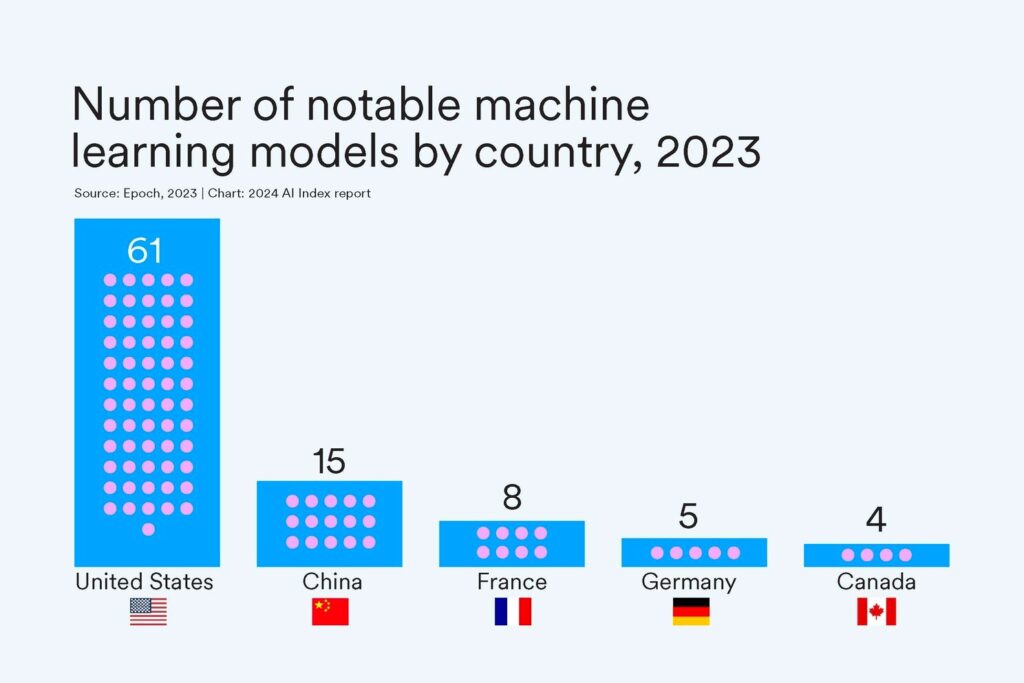
The US crushing – for now…
Google and OpenAI are at the forefront of this, releasing incredibly powerful foundation models that are achieving human-level performance on a variety of benchmarks. In terms of who’s doing what, industry accounted for nearly 75% of all new models in 2023 (as opposed to academia, government, etc.). However, this remarkable progress comes at a steep cost, with training expenses soaring into the hundreds of millions. Google’s Gemini Ultra alone cost an estimated $191 million to train (see pic 💸).
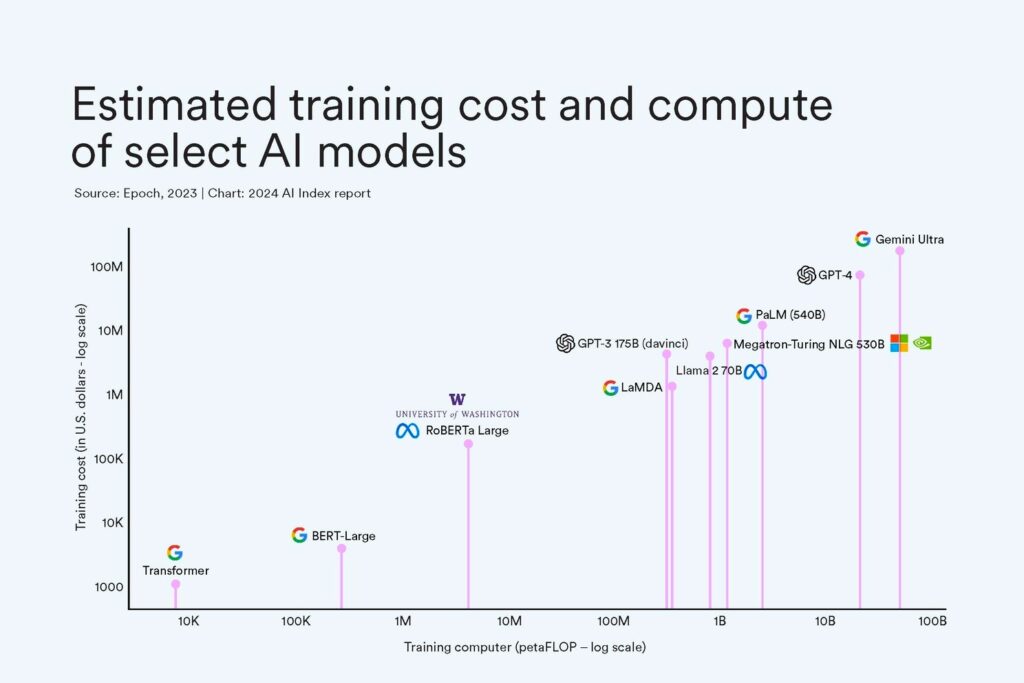
GPT-4 class AIs don’t come cheap
This just reflects the #bigbusiness nature of AI – 2023 saw $25.2 billion in investment despite an overall drop in AI funding – a nearly 30-fold increase from 2019, highlighting the growing interest and potential in this field. Other interesting elements reflect how people worldwide are grappling with AI’s potential impact on their livelihoods. More than 50% of people globally expect AI to significantly alter their jobs within the next five years, with younger generations and high-income earners anticipating the most substantial effects.
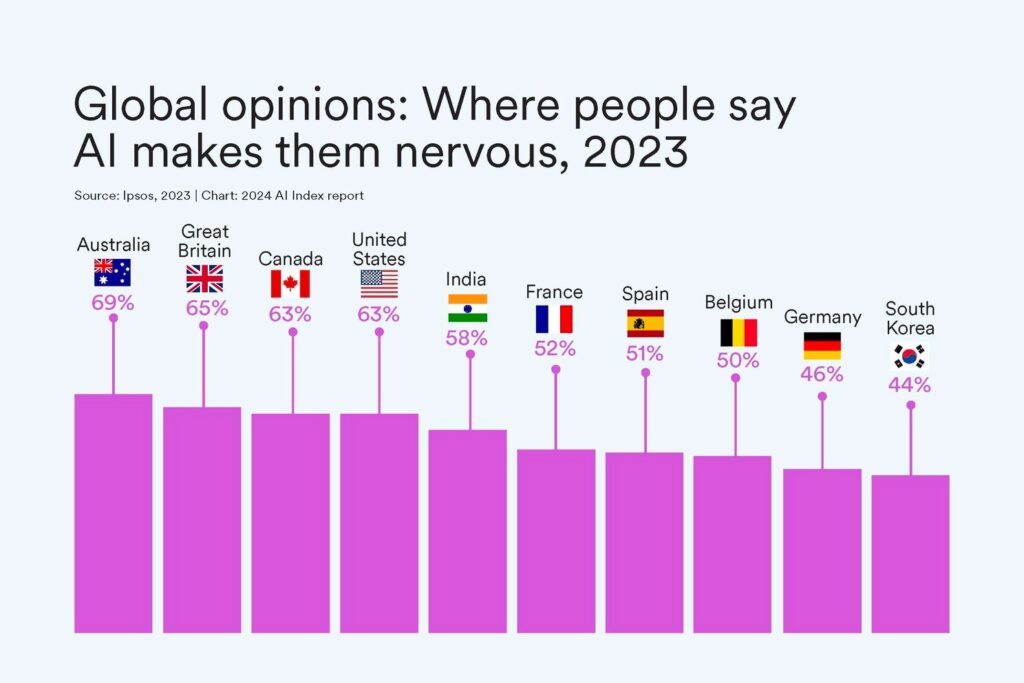
Interesting cultural differences and nervousness across the Anglosphere
The AI revolution is well underway, and it’s clear that we’re in for a transformative journey as this technology continues to shape our world. 🌍
From Humanoid Robots to Wearable AI: the Hardware Revolution
Speaking of technology (re)shaping our world, there’s been all kinds of interesting hardware developments recently. Not content with being outdone by Figure 1, Groot, or Tesla’s Optimus – Boston Dynamics, the OG of the humanoid robot space, has released its next-generation Atlas robot. Powered by electrics rather than hydraulics, it has omnidirectional limbs, 360° joints, and unparalleled agility – seriously, I challenge anyone to watch this video and not be impressed 😮
In the personal AI/electronics area, Humane’s wearable AI pin got an absolute tear-down by Marcus Brownlee whose video was titled “The Worst Product I’ve Ever Reviewed … For Now” #ouch.
At $700 that’s some pretty serious feedback but probably fair as, despite its sleek design and futuristic vision, it’s been met with fairly universal criticism for its sluggish performance, inconsistent battery life, and lack of smartphone integration. And in a textbook case of “right time, right place” competitor Limitless AI have released a similar wearable product aiming to make personalised AI accessible for everyone – if nothing else, they’re much better at product pitches than Humane are: “Our vision is to free the human mind from its biological limits. If you believe in the potential for technology to augment our capabilities in ways that were unimaginable until now, we’re building for you”.
AI in Learning and Development: Industry Giants Embrace Innovation
In a world not too different from our own (i.e., that of Learning and Development), things are undergoing a significant transformation as AI innovations step up. The L&D Global Sentiment Survey reveals that in 2024, practitioners from leading organisations such as Bayer, Roche, Ericsson, and HSBC are actively exploring and implementing AI solutions across various aspects of their work, from content creation and curation to skills management, coaching, and performance support. As these industry giants navigate this new landscape, they are discovering the importance of strategic adoption, collaboration with the wider business, and a clear mandate from senior leadership to unlock the full potential of AI.
Case studies from these organisations showcase the breadth of AI applications in L&D. Bayer, for instance, has developed a secure large language model to summarise procedural documents and create role-based content, while Roche is experimenting with AI-powered coaching bots and personalised onboarding experiences. Ericsson has taken a community-driven approach to AI innovation, fostering a culture of experimentation and collaboration across the organisation. HSBC, meanwhile, has demonstrated the impact of AI-powered coaching on contact centre performance, with agents using the tool showing significant improvements in quality scores. Interesting stuff and potentially some great lessons we could apply in our own contexts…
Generative AI Revolutionises Video Editing: Adobe and Microsoft lead the way
Adobe is making waves in the world of video editing with the introduction of generative AI features in Premiere Pro, powered by their cutting-edge Adobe Firefly video model. These revolutionary tools, including Object Addition, Object Removal, and Generative Extend, are set to transform the way editors work, allowing them to manipulate footage and add elements with unprecedented ease and precision. Case in point, remember when Game of Thrones broke the 4th wall in season 8 by serving Daenerys a venti latte from Starbucks? Imagine just being able to deal with that in post-production 😮💨… (tho there still would have been that entire mess that was Season 8 to deal with – fantastic Pitch Meeting teardown here for anyone still stinging from that).
But Adobe isn’t stopping there. In a very interesting move, they’re also exploring collaborations with third-party generative AI models like OpenAI’s Sora, Runway AI’s video model, and Pika, giving editors the ability to generate new video to spec for projects and injecting AI directly into workflows. This will have profound consequences for the industry – probably for good and for ill.
Meanwhile, Microsoft has their own HeyGen now. Vasa 1, a groundbreaking model that brings static images to life by creating extremely lifelike talking faces, achieves an near unparalleled level of realism and expressiveness in the avatars it creates. Interesting sidebar that that’s a Microsoft product btw – is this MS AI’s new boss Mustafa Suleyman starting to make his presence felt? Oh and Meta’s Imagine Flash allows you to edit AI images in real time – and then animate it. So just minor stuff really – and coming to WhatsApp, Messenger, etc. very very soon 🤯.
We hope this edition of the newsletter has been of interest to you. If you’re new here and it’s been useful, please do click subscribe and you can expect a weekly update every Monday from now on. If you’re already a subscriber – thanks for your ongoing interest and support! Either way, if you know others who might benefit from reading this weekly, please forward it on to them too.
Have a great weekend ahead and let us know if there’s anything we’re missing that we should add to make this newsletter more useful for i) yourself and/or ii) others. This is a fast-moving, ever-evolving space and we greatly value any and all feedback. 🙏