Hi
Hope you had a wonderful weekend wherever you are. Apologies for the radio silence the last week – as I mentioned in the last post, we were on holiday for Vietnam Independence Day.
For all that, it’s been an eventful week here – the week started on An Bang beach outside of Hoi An (if you’ve not been, I recommend – it’s lush – see pic at bottom) and ended back in Hanoi hunkering down as we weathered our way through Typhoon Yagi – the strongest storm in Asia this year. It was a pretty wild night but thankfully we avoided the worst of it – our thoughts are obviously with those who weren’t so lucky. Either way, a definite week full of contrasts 😵💫
Anyway, the world of AI hasn’t been on holiday so let’s get straight into it:
AI’s $15.7 Trillion-Dollar Question: How Will It Transform Our Economy?
Imagine an economic boost larger than the current output of China and India combined. That’s the potential impact of AI by 2030, according to PwC’s recent Global Artificial Intelligence Study – a whopping $15.7 trillion contribution to the global economy 🤯 PwC’s study paints a picture of an AI-driven future that’s both exciting and slightly intimidating. They’re projecting enormous potential GDP boosts with significant regional differences (e.g., China leading the charge at 26% gains, North America not far behind at 14.5%, but Latin America lagging with 5.4%). What drives this economic boost? 45% of it will reportedly come from product enhancements/increase in the variety of product offerings – think increased personalisation, affordability, etc.
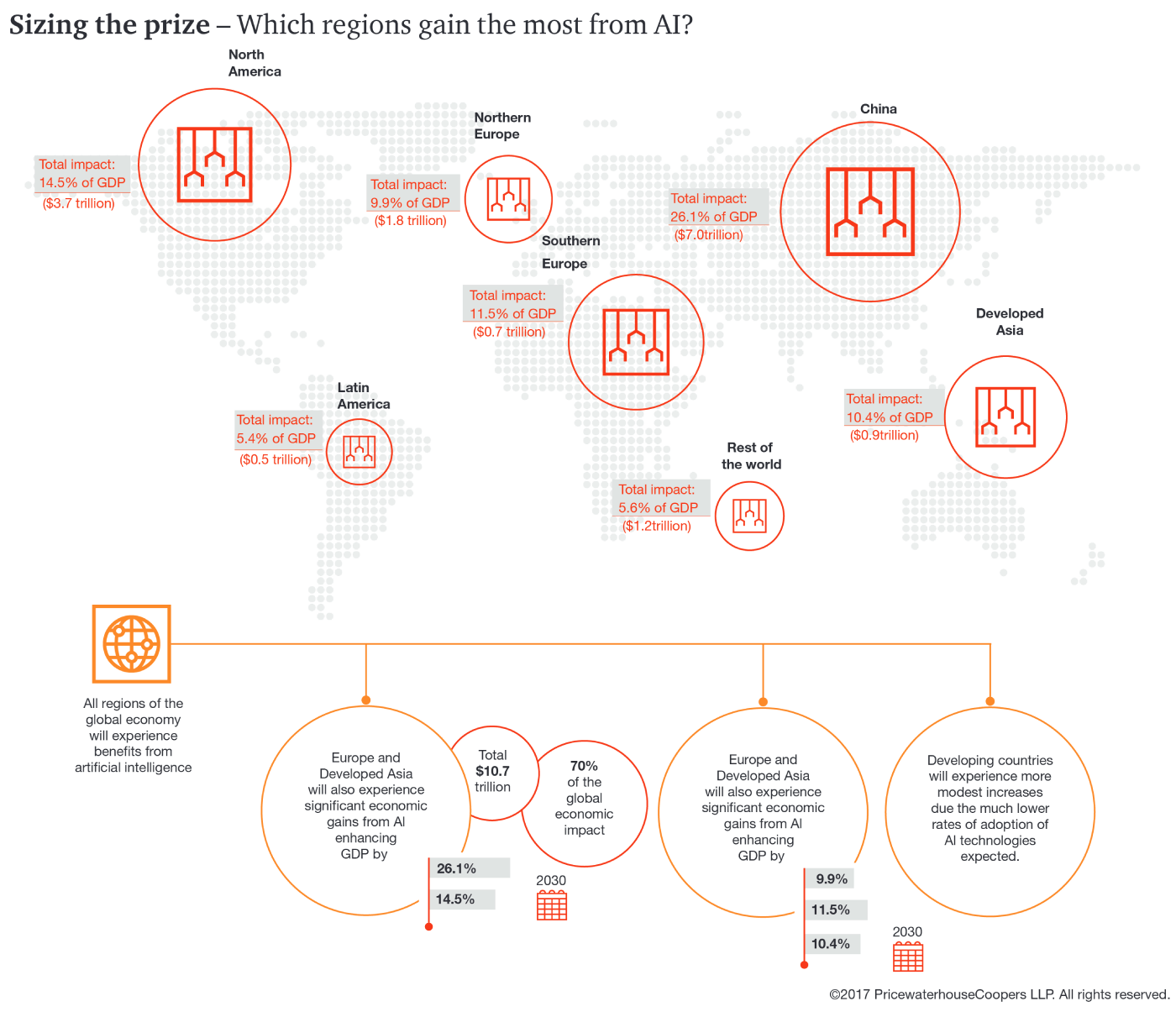
There are also significant sector differentials as well – interesting data interactive here or you can download the full report here. Sadly HE isn’t on there but the downstream impacts cover a wide range of areas from Healthcare, Automotive, Financial Services, Retail, Technology, Manufacturing, Energy, and Transportation & Logistics. If your area isn’t one of those, it probably abuts one or more. Either way there are good lessons to learn from this or, at the very least, a compelling call to action from one of the Big 4. Worth a read.
Amazon Taps Anthropic’s Claude for Alexa Revamp: A New Era for Voice Assistants?
Amazon is gearing up for a major Alexa upgrade, and surprisingly, they’re not going it alone. The tech giant is set to release a revamped version of Alexa in October, powered primarily by Anthropic’s Claude AI models rather than Amazon’s own technology. This move comes after initial versions using Amazon’s in-house software reportedly struggled with response times and coherence. The new “Remarkable” Alexa, expected to cost between $5 to $10 a month, aims to handle complex queries and carry on more natural conversations, potentially transforming how we interact with voice assistants.
Context: I used Google Assistant a lot when I had Android phones – it’s super useful – and, since I’ve made the switch to 🍎, I’ve always found Siri underwhelming. So when I heard you can replace Siri with a GPT-4 powered assistant, I was there in a flash – a year later, still a solid option. But being able to use Claude as an assistant – especially if it can take actions (unlike the Rabbit r1 – teardown by Coffeezilla here and Marques Brownlee here) – that would be amazing. Will be watching with real interest.
AI in Education: Contrasting Visions of the Future
The AI revolution in education is taking some fascinating turns, with different countries and institutions exploring contrasting approaches. In London, we’re seeing perhaps the most radical experiment yet – a private school is launching the UK’s first “teacherless” GCSE class. For £27,000 (a.k.a. 872m VND or $53k AUD) a year, students will learn entirely through AI platforms and VR headsets, with the technology adapting lesson plans based on individual strengths and weaknesses. It’s a bold vision of AI not just as a teaching aid, but as the primary educator. 👩🏫🤖
On the other end of the spectrum, we have more collaborative approaches. In Australia, the NSW Education Department is trialing NSWEduChat in 50 schools. Unlike the UK’s teacherless classroom, this AI tool is designed to work alongside teachers, prompting students to think critically rather than providing easy answers. It’s early days but initial results seem promising – improving student outcomes and access, reducing teacher workloads and, interestingly, student confidence. 🤔 Meanwhile, the UK government is taking a different tack altogether, opening up its educational resources to tech companies. The goal? To create AI tools that reduce teacher workloads by handling tasks like marking and lesson planning. It’s a vision of AI as a behind-the-scenes supporter, freeing up teachers to focus on face-to-face interaction with students. Great to see educators innovating with these new possibilities rather than techbros trying to cram through their vision for “saving education” – very encouraging stuff #moreofthisplease
Authentic Assessments: Bridging Education and Real-World Skills in the AI Era
How do we go about authentic assessment in the age of AI? A recent Monash University study of their online Master of Public Health and Health Administration programs offers a number of potentially intriguing answers to this question. Examining over 60 assignments across 19 units, they found 70% of assessments were ‘very authentic’, featuring tasks like policy analyses and case studies that mirror real-world scenarios. This approach aims to better prepare graduates for the complexities of their future professions – not a surprise necessarily for those institutions already leaning heavy into authentic assessment.
There are some interesting new ideas in the study tho with AI opening new doors – Monash researchers are exploring AI-driven simulations of public health crises, creating safe environments for students to apply their skills. Interesting use-cases are possible here with layered, staged prompts (e.g., Claude Artifacts or GPTs) – or if we string in automation tools like Zapier or Power Automate with various AI platforms – effectively “chaining” experiences for students and creating vivid, truly immersive (but not in the VR sense) learning and assessment experiences. 🤩
Runway 40-second generations
Runway continues to push boundaries in video x AI (and so, potential worldbuilding) – users can now generate videos up to 40 seconds long with Gen-3 Alpha Extensions. Looks super easy to do (tutorial from the Runway Academy here) and, while I’m not a film-maker, a 40-second shot sounds like a decent amount to work with to me – after all, now you can keep visual consistency, cuts and shots drive narrative right?
After all, not every movie is meant to be a one-shot wonder like 1917 #greatsegue. One last chance to plug Gen:48 – the Runway 48-hour film competition! The third edition of this competition is coming this weekend from 9am September 14th to 9am September 16th (EST). Fully remote with filmmakers from all over the world encouraged to participate 📹👀🍿
As we’ve seen, AI’s influence is expanding rapidly across various sectors, from global economics to classroom innovations and creative tools. While challenges and questions remain, the potential for AI to transform our world is undeniable. Stay tuned as we continue to track these exciting developments and their implications for our future.
Have a great week ahead and let us know if there’s anything we’re missing that we should add to make this newsletter more useful for i) yourself and/or ii) others. This is a fast-moving, ever-evolving space and we greatly value any and all feedback. 🙏

An Bang Beach at sunset looking north towards Da Nang #Iliveherenow